
Screenshots and videos
 1 / 8


Price history
Lowest recorded standalone price: $39.99. Recorded observations span to . This is our available history, not a guaranteed all-time low. Bundle package prices are separate.
Standalone price
Last three months, in USD. Bundle prices cover the whole package.
About Traffic Engine - Crowd
Up and running in under a minute.
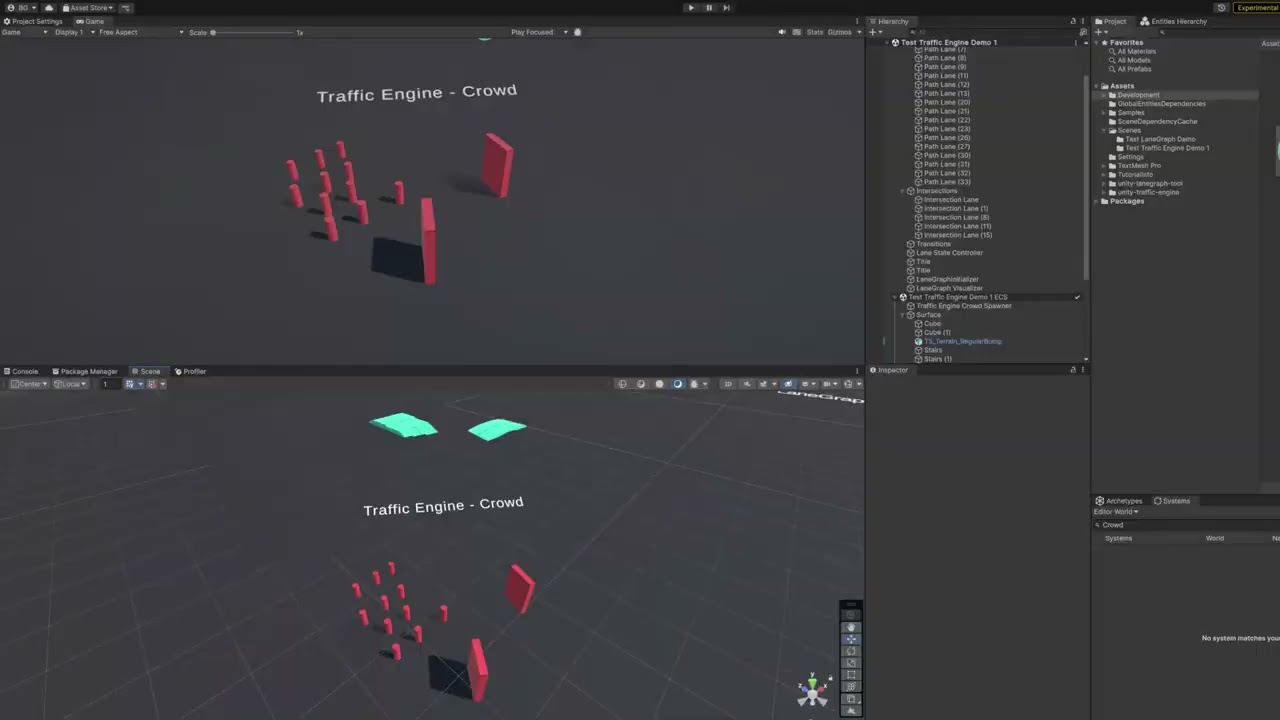
Create your pedestrian prefab, add TrafficCrowdAgentAuthoring. Drop a TrafficCrowdSpawnerAuthoring in your scene, point it at the prefab, set your count — done. Thousands of fully simulated DOTS entities, live in your scene with zero boilerplate.
TrafficEngine Crowd is a DOTS-native pedestrian simulation plugin for Unity. Every system runs as a Burst-compiled parallel job — no MonoBehaviour overhead, no polling loops. The simulation is built to hold frame budgets at crowd sizes where traditional approaches break down.
Agents navigate a lane graph using spline-based look-ahead, respond to traffic signals, queue behind congestion, avoid static obstacles, separate from each other, and conform to terrain surfaces including stairs and ramps. Each behaviour is isolated to its own system with a clear ownership contract — navigation writes intent, downstream systems modify it, movement commits the final result.
Navigation - Agents follow lane splines with a 2 m look-ahead for smooth directional sampling. Lane transitions, boundary containment, and dead-end reversals are all handled within the navigation pass.
Queuing & Traffic Signals - Each agent scans forward for red signals and congestion. A stop is only triggered by genuine blockage — preventing false stops from isolated stationary pedestrians. Queuing yields immediately if an avoidance commitment is active.
Agent Separation - ORCA-style separation forces are applied between neighbouring agents using spatial hash lookups. Head-on encounters automatically resolve to opposite sides with no shared state or write contention.
Obstacle Avoidance - A forward cast confirms a real obstacle before avoidance engages. Nine candidate rays fan around the lane forward axis, each measuring its navigable corridor depth against the lane boundary polygon before casting, then scoring on alignment, clearance, and temporal stability. The committed direction persists across frames to prevent oscillation.
Surface Conforming - Two raycasts per agent per frame keep agents grounded on terrain, ramps, and stairs. A grace period absorbs transient misses at step edges and physics seams before fall state engages.
LOD System - Three distance tiers implemented via enableable components. Full simulation at close range, progressively reduced at distance. No structural entity changes occur during transitions — just component enable/disable.
Spawner - Agents spawn inside valid lane boundaries with boundary compatibility pre-computed once at startup. Collider avoidance on spawn is configurable via layer mask to prevent agents spawning inside geometry(eg. obstacles).
More from Blackbyte Games
- Lane Graph $49.99
- Traffic Engine - Vehicle $69.99
- Animecs $39.99