Price history
Recorded standalone sale prices and the latest available store price, in USD. Historical dots use the sale start date and its recorded offer price. Prices can change during a sale; this is not a daily price log. Bundle prices and upcoming offers are excluded. History covers up to the 100 most recent recorded offers.
Lowest recorded standalone price in this history: $7.50. The latest store price is $15.
View 4 recorded prices
| Sale start / price check | Price | Observation |
|---|---|---|
| $15 | Latest store price | |
| $7.50 | Unity New Release Discount 2026-10-21 2026-10-28 | |
| $7.50 | Unity New Release Discount 2026-10-21 2026-10-28 | |
| $15 | Unity First Price 2026-10-21 2026-10-21 |
Sale and bundle history
The 3 most recent recorded offers including this asset. Past offers may no longer be available. Bundle prices cover a package, not this asset alone.
About Branchwork for Git
- Tools, Systems & Learning > Development Tools & Automation
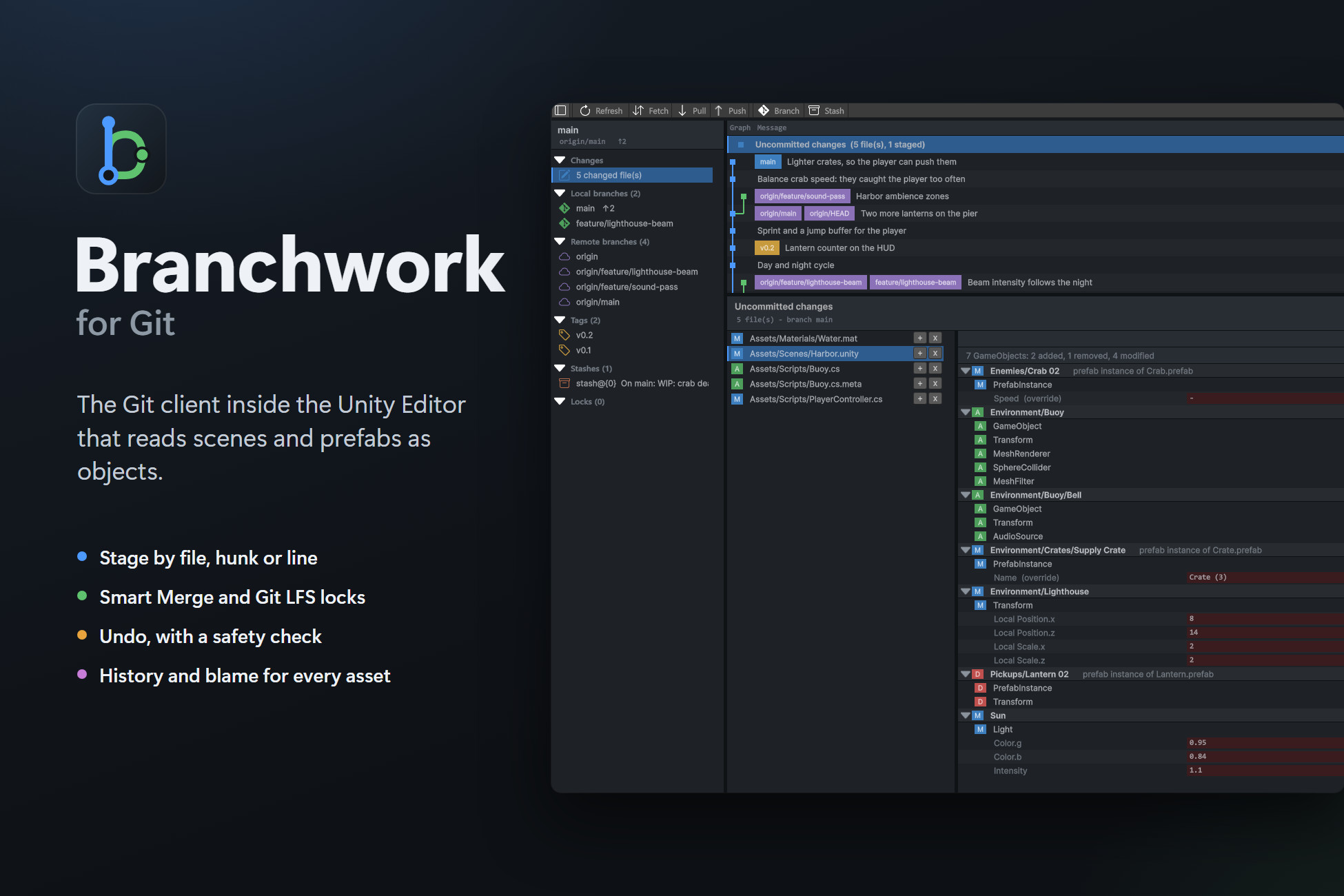
Branchwork is a Git client inside the Unity Editor. Your history, your changes and your branches sit in a dockable window, so you can commit, pull and push without switching to another app.
It's built around the problems Unity projects actually have with git. A scene change isn't a wall of YAML anymore: Branchwork lists the GameObjects, components and values that changed. Two people who edit the same scene can merge it, because Unity's Smart Merge is set up in one click. The scenes and prefabs someone is working on can be locked, so nobody saves over them. And before a commit, Branchwork catches what breaks a project on the other machines: assets without their .meta file, unsaved scenes, large files that should be in Git LFS.
Requires git. Branchwork uses the git 2.23 or newer installed on your computer, the same way your terminal does, so your credentials, hooks and Git LFS keep working as they are. It doesn't host repositories: you still need a Git server such as GitHub, GitLab, Bitbucket, Azure DevOps or Gitea.
Good to know
The Git repository must be rooted at the Unity project folder.
No clone, remote management, rebase or submodule support yet.
Conflicts are resolved with UnityYAMLMerge or your own tools. There's no built-in three-way merge view.
Branchwork never shows a password prompt: sign in once with a credential manager, or use an SSH agent.
Locks need Git LFS and a server with the LFS locking API (GitHub, GitLab and Gitea have it).
The object view needs Asset Serialization set to Force Text, and can't read files stored in Git LFS.
Developed and tested on Windows. macOS and Linux editors are supported, with less testing so far.
Editor-only: nothing is added to your builds. No analytics, no account.
It's built around the problems Unity projects actually have with git. A scene change isn't a wall of YAML anymore: Branchwork lists the GameObjects, components and values that changed. Two people who edit the same scene can merge it, because Unity's Smart Merge is set up in one click. The scenes and prefabs someone is working on can be locked, so nobody saves over them. And before a commit, Branchwork catches what breaks a project on the other machines: assets without their .meta file, unsaved scenes, large files that should be in Git LFS.
Requires git. Branchwork uses the git 2.23 or newer installed on your computer, the same way your terminal does, so your credentials, hooks and Git LFS keep working as they are. It doesn't host repositories: you still need a Git server such as GitHub, GitLab, Bitbucket, Azure DevOps or Gitea.
Good to know
The Git repository must be rooted at the Unity project folder.
No clone, remote management, rebase or submodule support yet.
Conflicts are resolved with UnityYAMLMerge or your own tools. There's no built-in three-way merge view.
Branchwork never shows a password prompt: sign in once with a credential manager, or use an SSH agent.
Locks need Git LFS and a server with the LFS locking API (GitHub, GitLab and Gitea have it).
The object view needs Asset Serialization set to Force Text, and can't read files stored in Git LFS.
Developed and tested on Windows. macOS and Linux editors are supported, with less testing so far.
Editor-only: nothing is added to your builds. No analytics, no account.