Price history
Recorded standalone sale prices and the latest available store price, in USD. Historical dots use the sale start date and its recorded offer price. Prices can change during a sale; this is not a daily price log. Bundle prices and upcoming offers are excluded. History covers up to the 100 most recent recorded offers.
Lowest recorded standalone price in this history: $10. The latest store price is $10, matching the lowest recorded price shown here.
View 2 recorded prices
| Sale start / price check | Price | Observation |
|---|---|---|
| $10 | Latest store price | |
| $10 | Unity First Price 2026-06-19 2026-06-26 |
Sale and bundle history
The 1 most recent recorded offers including this asset. Past offers may no longer be available. Bundle prices cover a package, not this asset alone.
About Sliding Puzzle Factory
- Tools, Systems & Learning > Game Templates & Systems
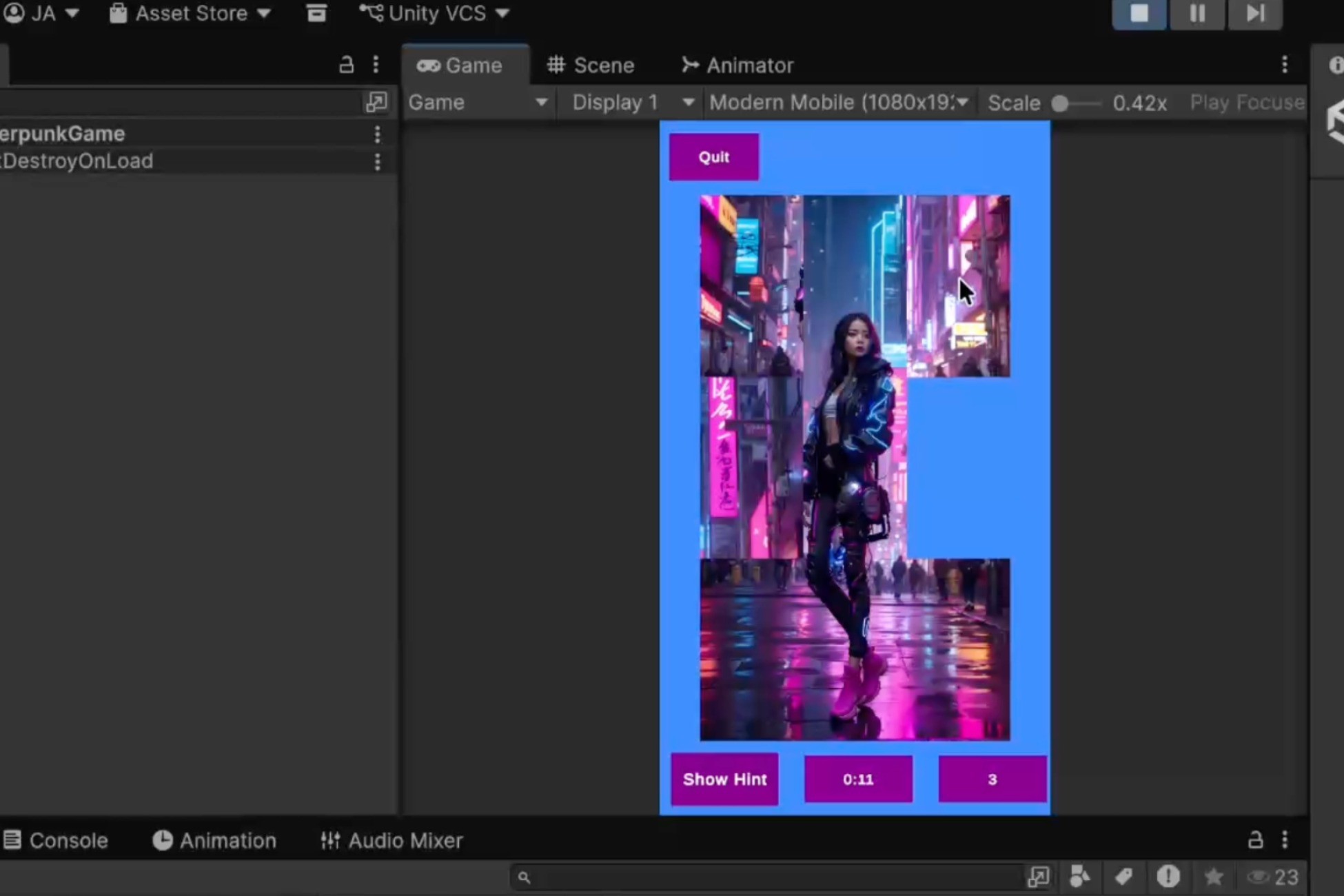
Sliding Puzzle Factory ships with two fully playable example games — a coral reef theme and a cyberpunk theme — so you can see exactly what you're building before you write a single line of code. Both are included as importable samples, with every scene, script, and animation available to study and adapt.
Underneath the examples is a production-ready framework that handles the full game lifecycle: main menu flow, difficulty selection, session management, score persistence, theme propagation, and portrait/landscape orientation switching. The puzzle board itself (SlidingPuzzleKit) is bundled — no separate install required.
The workflow is straightforward: create one config asset with your levels, difficulty tiers, colors, and background art, then subclass the provided base classes to plug in your own transitions and animations. The framework takes care of the rest.
What the package handles for you:
- Complete main menu flow: title screen → hub → level list → level detail → game → completion overlay
- Difficulty tiers with configurable grid sizes and shuffle behaviour
- Per-level best-score persistence (best move count and best time tracked independently)
- Theme propagation: brand colors and background sprite pushed to all UI in one call
- Portrait/landscape orientation switching with per-branch UI visibility
- Timer with enable/disable toggle, hint overlay toggle, and mid-game quit confirmation
Limitations to be aware of:
- The package provides the architecture and wiring; you supply all art, prefabs, and animations. There are no ready-to-ship visual assets — the sample games' art is for reference only.
- The base classes require subclassing — they cannot be dropped into a scene without code. The included sample scenes and step-by-step documentation walk you through the process.
- Score storage uses PlayerPrefs. If your game requires cloud saves or a custom persistence backend, you will need to replace the score layer.