About Asset References for Game Creator 2
- Tools, Systems & Learning > Development Tools & Automation
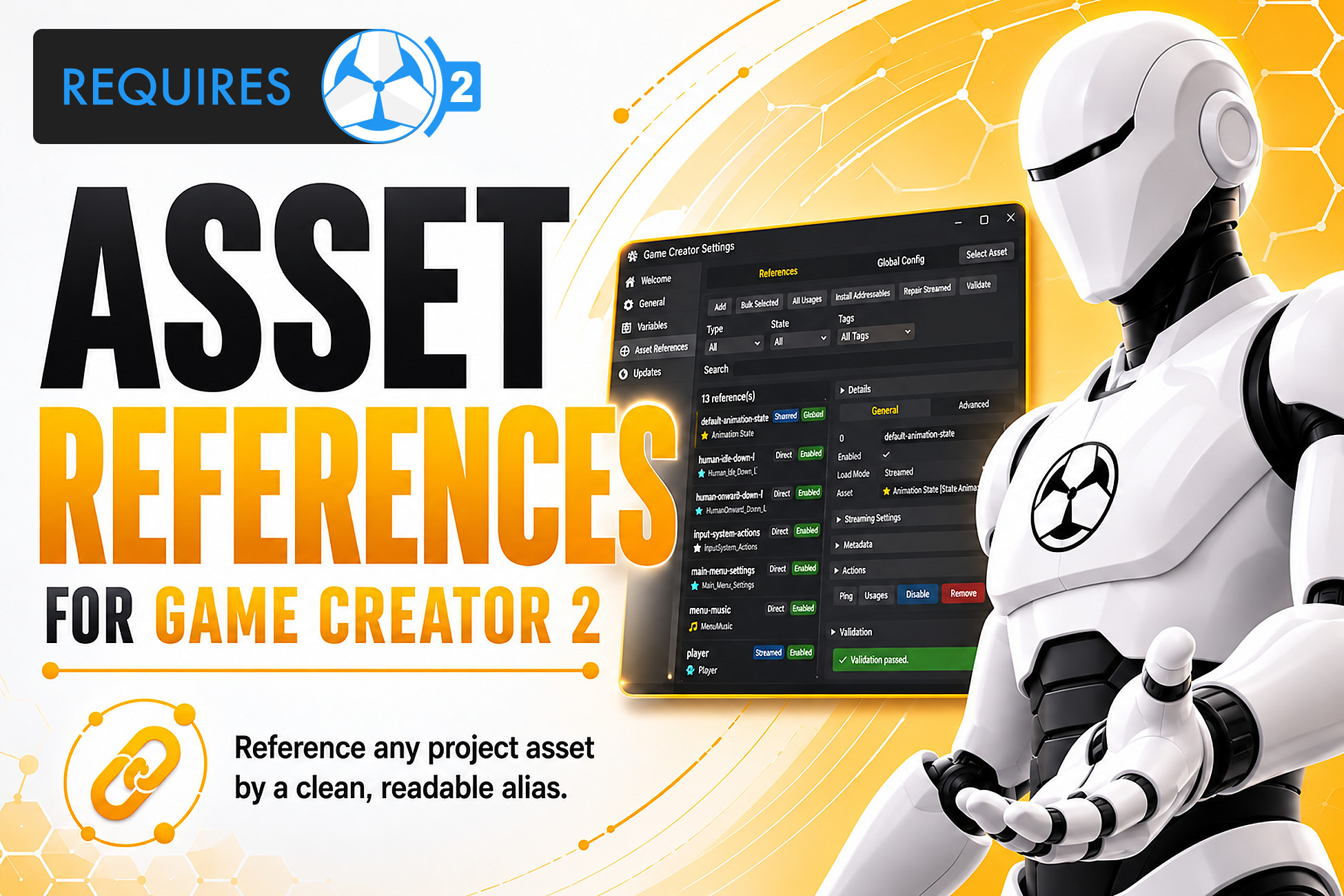
Asset References for Game Creator 2 gives you a clean, powerful, and designer-friendly way to reference project assets directly inside Game Creator 2.
Create stable Reference IDs for prefabs, audio clips, materials, sprites, textures, animation clips, scenes, and more — then use them across GC2 Properties, Conditions, Instructions, and Events without constantly dragging references around your project.
No messy scene dependencies.
No repeated manual assignments.
No fragile hardcoded paths.
Just clean, searchable, reusable asset references built for real production workflows.
Deep Game Creator 2 Integration
Built to feel natural inside Game Creator 2:
• Properties
Get references for GameObject, AudioClip, Material, Sprite, Texture, Texture2D, AnimationClip, and Scene build index.
• Conditions
Check whether a reference exists, is loaded, is enabled, or which load mode it uses: Direct or Streamed.
• Instructions
Preload streamed assets, release streamed assets, release all streamed assets, and resolve supported asset types directly into GC2 variables.
• Events
React when an asset reference is resolved, loaded, released, or missing.
Events can listen globally or filter by a specific Reference ID.
Powerful Database Editor Window
Manage your entire asset reference library from one dedicated editor window.
• Search & Filter
Quickly search metadata and filter by asset type, state, category, or custom tags.
• Usage Scanning
Find exactly which serialized assets are using a specific Reference ID.
Perfect for renaming, cleanup, refactoring, and avoiding broken references.
• Validation Suite
Run one-click validation to detect missing assets, duplicate IDs, scene object references, disabled references, and mismatched Addressables metadata.
• Rapid Workflow
Add references directly from the Inspector, register selected assets, or use context-menu bulk generation tools.
• C# Code Snippet Exporter
Copy raw IDs or static runtime API snippets like AssetReferences.Get() directly into your custom scripts.
Dynamic Addressables-Backed Streaming
For larger projects, Asset References supports streamed assets using Unity Addressables.
• Preload Policies
Choose between Auto, Preload On Start, On Scene Load, or Manual loading.
• Release Policies
Use Auto release on scene change, Manual release, or Immediate release after resolving.
• Integrated Addressables Tools
See real-time sync status, detect mismatches, sync assets with one click, repair metadata manually, and automatically unregister assets when needed.
Performance Optimized Runtime
Designed to stay lightweight, safe, and fast during gameplay.
• Fast dictionary-based lookup cache
• Safe synchronous and asynchronous APIs
• TryGet support for graceful missing-asset handling
• No heavy editor database scanning during runtime
• Clean separation between editor tooling and runtime resolving
Your assets stay organized in the Editor, while runtime lookups remain simple and efficient.
Create stable Reference IDs for prefabs, audio clips, materials, sprites, textures, animation clips, scenes, and more — then use them across GC2 Properties, Conditions, Instructions, and Events without constantly dragging references around your project.
No messy scene dependencies.
No repeated manual assignments.
No fragile hardcoded paths.
Just clean, searchable, reusable asset references built for real production workflows.
Deep Game Creator 2 Integration
Built to feel natural inside Game Creator 2:
• Properties
Get references for GameObject, AudioClip, Material, Sprite, Texture, Texture2D, AnimationClip, and Scene build index.
• Conditions
Check whether a reference exists, is loaded, is enabled, or which load mode it uses: Direct or Streamed.
• Instructions
Preload streamed assets, release streamed assets, release all streamed assets, and resolve supported asset types directly into GC2 variables.
• Events
React when an asset reference is resolved, loaded, released, or missing.
Events can listen globally or filter by a specific Reference ID.
Powerful Database Editor Window
Manage your entire asset reference library from one dedicated editor window.
• Search & Filter
Quickly search metadata and filter by asset type, state, category, or custom tags.
• Usage Scanning
Find exactly which serialized assets are using a specific Reference ID.
Perfect for renaming, cleanup, refactoring, and avoiding broken references.
• Validation Suite
Run one-click validation to detect missing assets, duplicate IDs, scene object references, disabled references, and mismatched Addressables metadata.
• Rapid Workflow
Add references directly from the Inspector, register selected assets, or use context-menu bulk generation tools.
• C# Code Snippet Exporter
Copy raw IDs or static runtime API snippets like AssetReferences.Get() directly into your custom scripts.
Dynamic Addressables-Backed Streaming
For larger projects, Asset References supports streamed assets using Unity Addressables.
• Preload Policies
Choose between Auto, Preload On Start, On Scene Load, or Manual loading.
• Release Policies
Use Auto release on scene change, Manual release, or Immediate release after resolving.
• Integrated Addressables Tools
See real-time sync status, detect mismatches, sync assets with one click, repair metadata manually, and automatically unregister assets when needed.
Performance Optimized Runtime
Designed to stay lightweight, safe, and fast during gameplay.
• Fast dictionary-based lookup cache
• Safe synchronous and asynchronous APIs
• TryGet support for graceful missing-asset handling
• No heavy editor database scanning during runtime
• Clean separation between editor tooling and runtime resolving
Your assets stay organized in the Editor, while runtime lookups remain simple and efficient.