Price history
Recorded standalone sale prices and the latest available store price, in USD. Historical dots use the sale start date and its recorded offer price. Prices can change during a sale; this is not a daily price log. Bundle prices and upcoming offers are excluded. History covers up to the 100 most recent recorded offers.
Lowest recorded standalone price in this history: $20. The latest store price is $20, matching the lowest recorded price shown here.
View 3 recorded prices
| Sale start / price check | Price | Observation |
|---|---|---|
| $20 | Latest store price | |
| $20 | Unity Permanent Decrease 2026-09-18 2026-09-25 | |
| $49.99 | Unity First Price 2026-09-11 2026-09-11 |
Sale and bundle history
The 2 most recent recorded offers including this asset. Past offers may no longer be available. Bundle prices cover a package, not this asset alone.
About Real Flame — Screen-Space Fire, Heat Haze, Embers, Smoke & Scorched Surfaces
- Theme > Realistic
- Art & Visuals > VFX
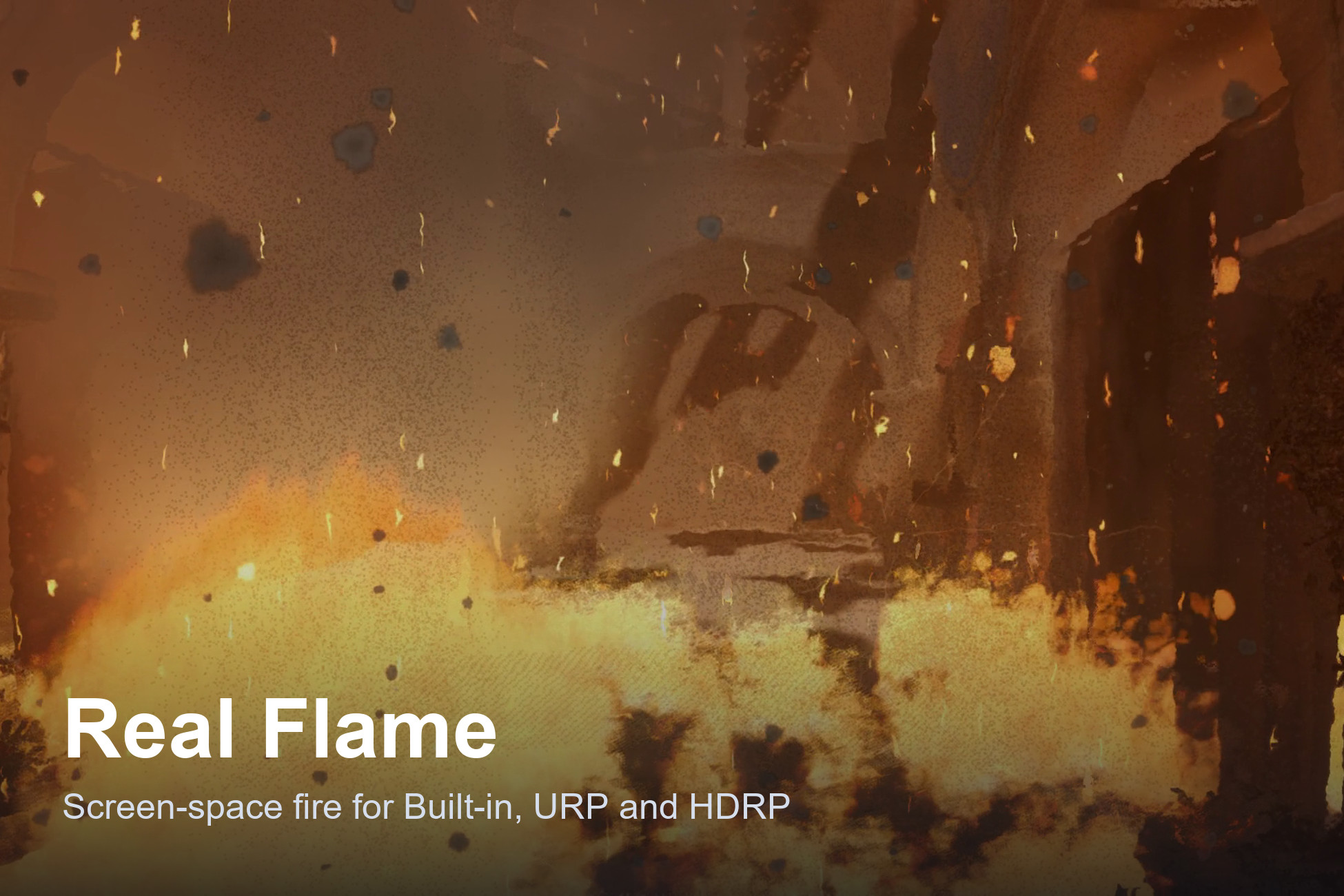
Real Flame turns any scene into a fire scene without touching a single material or placing a particle system. It is a fullscreen post-effect driven by Volume profiles: drop the Real Flame Rig into the scene, add a fire source or two, raise Blaze in the Volume, and the world catches fire.
Everything can burn. Real Flame derives fire from the depth buffer itself. A burn front sweeps across floors, walls, ceilings and props from your fire sources (or from random seeds), flames stand on every burning surface and climb up walls, surfaces blacken with soot within seconds and keep glowing embers as they burn out. Coverage, spread speed, burn duration and flame height are Volume parameters, so a campfire, a burning room, a house fire, a wildfire and the smouldering aftermath are presets of one system.
Material-aware. Tag renderers with Real Flame Surface (or let the scene scanner classify them by material): metal never flames but heats to a dull red glow, cloth and paper flash up, wood burns long, stone only soots. The tags are read per pixel through a lightweight material mask.
Real fire, not sprites. Flames are raymarched volumes of transparent, refracting hot gas with a black-body colour ramp, turbulence baked into a tiling 3D noise texture, smoke lit from below, depth-gated heat haze, radial glow, sparks with real Shuriken embers spawned on burning surfaces, falling ash, and the fire's own flickering point lights. Smoke pools under ceilings and rises over open ground using a top-down ceiling map; ash never falls indoors.
Camera effects. Ash and soot land on the lens, sparks hit the glass and cool to dark specks, hot air wobbles the whole image near a fire, a warm vignette closes in. All of it follows the camera's motion and the Volume blend.
Three pipelines, one system. Built-in, URP (Render Graph) and HDRP (Custom Post Process) share one shader body and identical Volume parameters. The Setup wizard installs the renderer feature or custom post-process, generates the pipeline wrappers and creates the ten preset profiles: Campfire, Torches, Burning Room, House Fire, Wildfire, Inferno, Ember Storm, Aftermath and a Stylized pair.
In the box
Fullscreen fire effect for Built-in, URP 17 and HDRP 17 (Unity 6000.3)
Real Flame Rig (ceiling map, source collection, material mask), Real Flame Source (radius, height, intensity, flicker, hidden fire light, Ignite/Extinguish API), Real Flame Surface (fuel tags) and the Ember Emitter
Ten Volume presets, generated per pipeline by the wizard
Setup wizard, noise baker, scene material scanner
Two sample scenes with baked lighting (Sandbox, Burning Street)
Manual, changelog, third-party notices (none: all code and textures are original)
Requirements and notes
Unity 6000.3.21f1 or newer; URP 17.3 / HDRP 17.3 for the SRP paths (Render Graph only)
HDR rendering with bloom and a tonemapper is strongly recommended (the samples enable them); TAA or DLSS smooths the volumetric march
Cost, measured in a URP player on an RTX 4090 at 1920x1080 with the blaze fully developed: Campfire 0.85 ms, Aftermath 1.4 ms, House Fire 2.5 ms, Inferno 2.8 ms (about half at 1280x720). One full-screen pass that scales with pixel count; expect several times these numbers on mid-range GPUs, and use a lower resolution scale or fewer flame steps there
Screen-space by design: flames exist where the depth buffer has surfaces; the material mask adds one extra pass over the opaque geometry (toggle per Volume)