Price history
Recorded standalone sale prices and the latest available store price, in USD. Historical dots use the sale start date and its recorded offer price. Prices can change during a sale; this is not a daily price log. Bundle prices and upcoming offers are excluded. History covers up to the 100 most recent recorded offers.
Lowest recorded standalone price in this history: $15. The latest store price is $15, matching the lowest recorded price shown here.
View 2 recorded prices
| Sale start / price check | Price | Observation |
|---|---|---|
| $15 | Latest store price | |
| $15 | Unity First Price 2026-06-20 2026-06-27 |
Sale and bundle history
The 1 most recent recorded offers including this asset. Past offers may no longer be available. Bundle prices cover a package, not this asset alone.
About Quest Pixel Display - VR URP LCD Shader
- Theme > Realistic
- Art & Visuals > VFX
- Art & Visuals > Textures & Materials
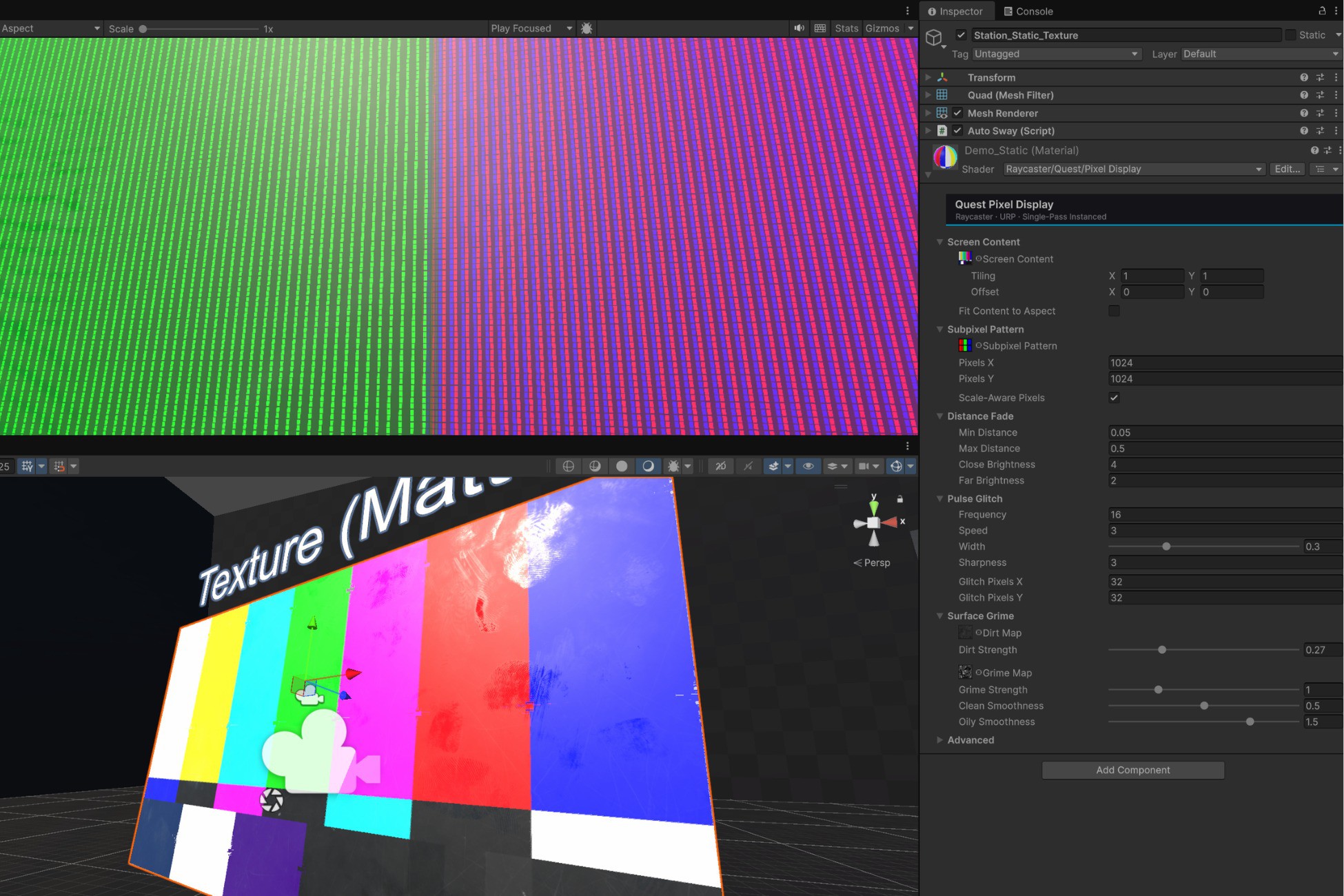
Make every monitor, TV, and CRT in your VR scene look like a real glowing display. Quest Pixel Display is a URP surface shader that layers a physically-believable LCD subpixel grid, dirt, grime, and an optional pulse glitch over any image, video, or RenderTexture you point at it, all from a single material in one forward pass.
Built specifically for Meta Quest 2 and Quest 3 under the Universal Render Pipeline. Single-Pass Instanced stereo, SRP Batcher compatible, four texture samples per fragment, and Adreno-friendly fragment ALU. It looks right on a default Unity Quad with zero configuration, then opens up to deep customization through a branded material inspector.
This is a surface shader, not a post-process. It runs on a 3D mesh such as quad, a TV model, an arcade cabinet and makes that mesh look like a physical display in your scene. It does not affect the camera output or full-frame rendering.
Walk up to a screen in VR and watch real RGB subpixels resolve out of the surface: the unmistakable moment your players realize they're looking at a physical display, not a texture.
Works with mobile & PC too!
Fully customizable
Every aspect of the look is exposed on the material: subpixel tile count, near/far brightness, glitch frequency and width, dirt and grime strength, and clean/oily smoothness response. Scale-Aware Pixels keeps cells physically square on any mesh shape;
Genre fit
Designed for sci-fi, retro-tech, horror, and cyberpunk VR. Use it on cockpit instrument panels, arcade cabinets, security monitors, in-world TVs and computer screens, dystopian advertising boards, broken-down terminals, retro CRTs, hacker laptops, signage, and HUD diegetics.