Unity
Particles Ghost Mesh
$49
Rated 5.0/5 from 3 ratings on Unity.
About Particles Ghost Mesh
- Art & Visuals > VFX
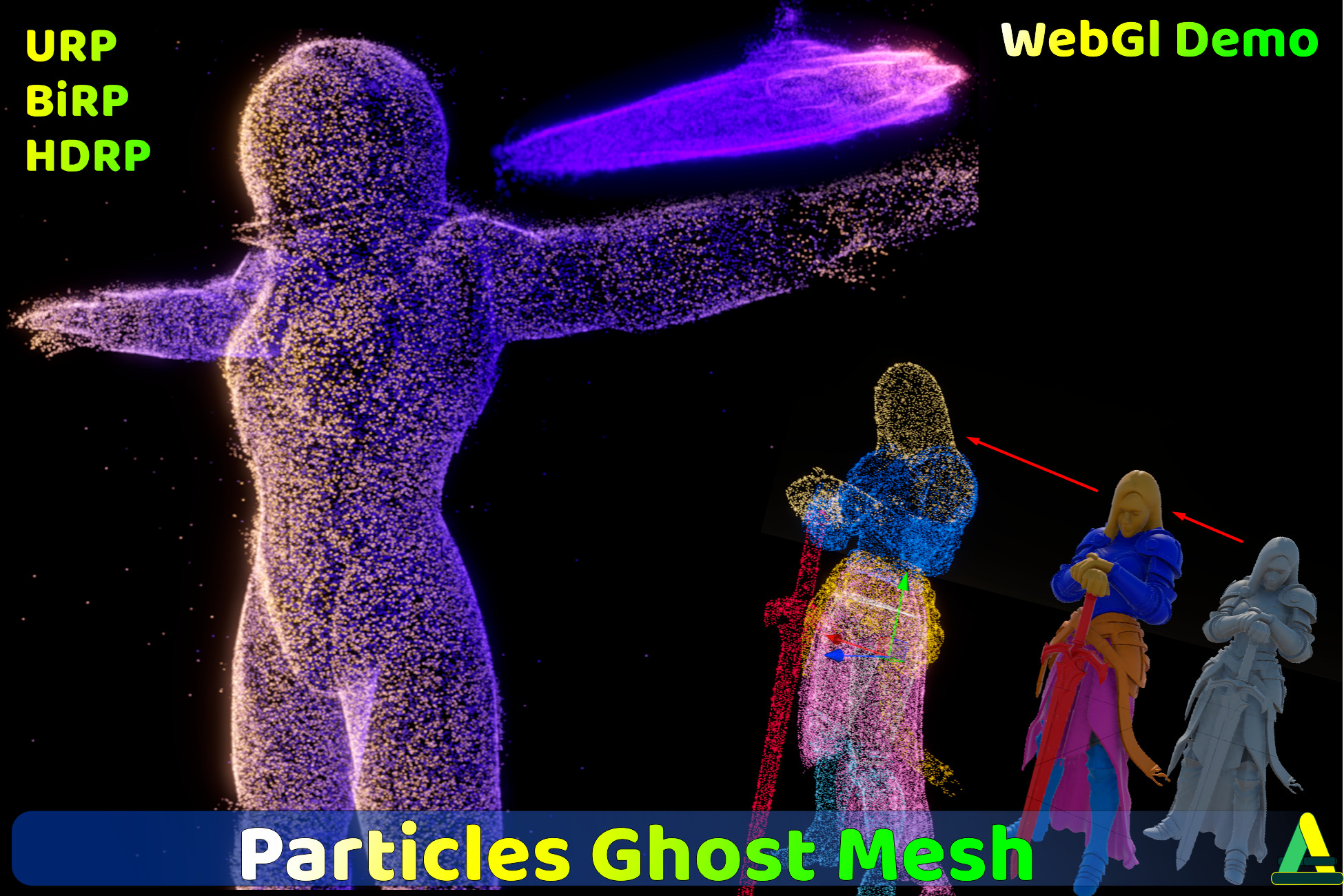
Turn your mesh into a ghost, a hologram, or a cloud of drifting embers. The baker converts geometry into a point cloud stored in two compact textures, and from that moment the original model is no longer part of the effect. The source mesh can stay out of the build entirely; the cloud does not reference it.
That is how you get spirits and apparitions, holographic UI and sci-fi scanners, dissolve and respawn transitions, logo intros, data visualization, and landing-page scenes, all from models you already have in the project. Any mesh you can import is a valid source, from a single prop to a whole environment hierarchy.
At runtime the whole effect is one mesh, one material, and one draw call. There are no compute shaders or GraphicsBuffers anywhere in the pipeline, which is exactly why it runs in a browser tab and on a phone where compute-based particle systems refuse to start.
Built for mobile and web.
The simulation is a fragment shader blit on a pair of ping-pong render textures. The shader target is 3.5. This keeps the asset compatible with WebGL2, WebGPU, Android, and iOS, where compute-based particle systems simply refuse to work. Point size is clamped in pixels, so a 160k point cloud stays readable and cheap at any resolution and on any screen.
One component, five systems.
Drop the Liquid Mesh Particles component on an empty object, assign a baked cloud, and get pointer repulsion, wind, flow, HDR gradients, and material palette tinting from the same inspector. Every system is independent and switches off by setting a single value to zero, with no shader variants or keyword permutations.
A real baker, not a random scatter.
The Point Cloud Baker merges every MeshFilter under a source object, welds coincident vertices, distributes points by triangle area, and then runs a Poisson rejection pass so the result has an even minimum spacing instead of the clumps from naive sampling. Hard edges can be walked separately so silhouettes and creases stay sharp at low point counts. Material colors are collected into a palette of up to 32 entries, so a multi-material model keeps its color identity in the cloud.
Full source, no black boxes.
Three C# files, three shader files, and one shared HLSL include. No DLLs, no third-party dependencies, and no hidden runtime. Read it, edit it, ship it.