Price history
Recorded standalone sale prices and the latest available store price, in USD. Historical dots use the sale start date and its recorded offer price. Prices can change during a sale; this is not a daily price log. Bundle prices and upcoming offers are excluded. History covers up to the 100 most recent recorded offers.
Lowest recorded standalone price in this history: $34.99.
View 3 recorded prices
| Sale start / price check | Price | Observation |
|---|---|---|
| $34.99 | Unity New Release Discount 2026-08-07 2026-08-21 | |
| $34.99 | Unity New Release Discount 2026-08-07 2026-08-21 | |
| $49.99 | Unity First Price 2026-08-07 2026-08-07 |
Sale and bundle history
The 3 most recent recorded offers including this asset. Past offers may no longer be available. Bundle prices cover a package, not this asset alone.
About DataGraph
- Tools, Systems & Learning > Development Tools & Automation
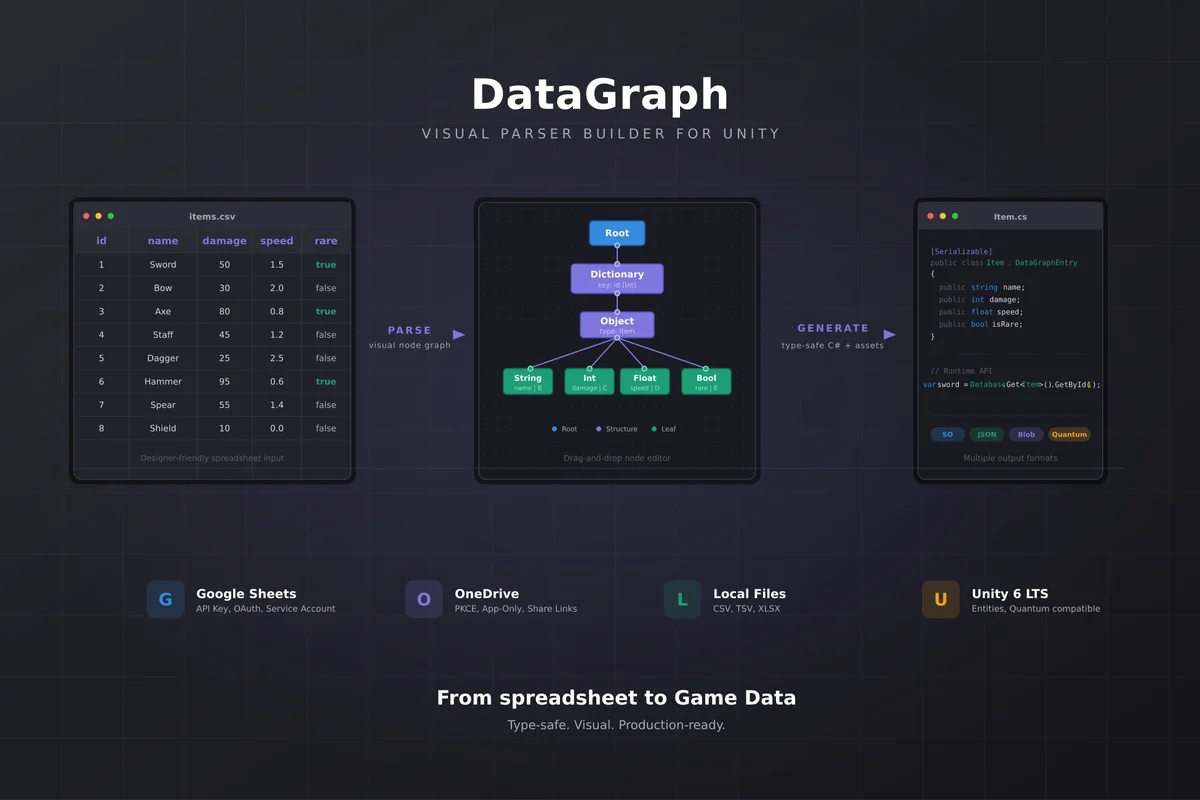
DataGraph is a visual editor tool for Unity that turns spreadsheet data into strongly-typed C# game data without writing import scripts or deserializers.
THE PROBLEM
Game config lives in spreadsheets (designers love them), but Unity speaks ScriptableObjects. Bridging the two usually means custom CSV importers that break every time a designer renames a column, JSON deserialization boilerplate, and schema drift between your code and your data.
THE SOLUTION
Open the DataGraph editor, wire a few nodes that describe how columns map to types. Click Parse. Get type-safe C# classes, populated ScriptableObject assets, and a runtime API in one go.
USE CASES
• Item / weapon / gear databases (Dictionary with damage, rarity, asset references)
• Level / wave / quest configurations (sequential or keyed)
• Localization tables (Dictionary with multi-language strings)
• Hero / character stats with nested sub-structures
• Skill trees with multi-level nesting (vertical arrays of arrays)
• Game-wide configuration (single Object root)
• Generated enums and [Flags] types from name+value tables
• Cross-graph references — items reference rarities, spells reference element flags
CUSTOMIZABLE
• Define your own schema visually — five graph types and nine leaf types cover almost any flat-or-nested config layout
• Three data sources: Google Sheets (API Key / OAuth / Service Account for CI), OneDrive / SharePoint (OAuth PKCE / App-Only / public share link), or local CSV / TSV / XLSX
• Four output formats — generate any combination from the same graph
GENRE FIT
Anywhere config volume is non-trivial: RPGs, MOBAs, deck builders, strategy games, MMOs, simulation games, idle / clicker games, character collectors. If your designer asks "can we move all this stuff into a Google Sheet?" — this is the bridge.
INCLUDED
• 8 pre-built sample graphs covering each common pattern (Item DB, Game Config, Localization, Hero Stats, Hero Skills with nested arrays, Rarity Enum, Element Flags, Composite Item with cross-graph references)