Price history
Recorded standalone sale prices and the latest available store price, in USD. Historical dots use the sale start date and its recorded offer price. Prices can change during a sale; this is not a daily price log. Bundle prices and upcoming offers are excluded. History covers up to the 100 most recent recorded offers.
Lowest recorded standalone price in this history: $17.50. The latest store price is $35.
View 3 recorded prices
| Sale start / price check | Price | Observation |
|---|---|---|
| $35 | Latest store price | |
| $35 | Unity First Price 2026-09-04 2026-09-04 | |
| $17.50 | Unity New Release Discount 2026-08-31 2026-09-14 |
Sale and bundle history
The 2 most recent recorded offers including this asset. Past offers may no longer be available. Bundle prices cover a package, not this asset alone.
About Texture Ledger: Smart Memory Auditor
- Tools, Systems & Learning > Development Tools & Automation
Why this exists
The inspector tells you a texture's dimensions and format. It doesn't tell you what that costs, and it certainly doesn't tell you which forty of your two thousand textures are worth an afternoon
Texture Ledger answers both, and then lets you act on the answer in the same window. The measurement is honest arithmetic rather than a rule of thumb, and every step of it is documented in the tool itself
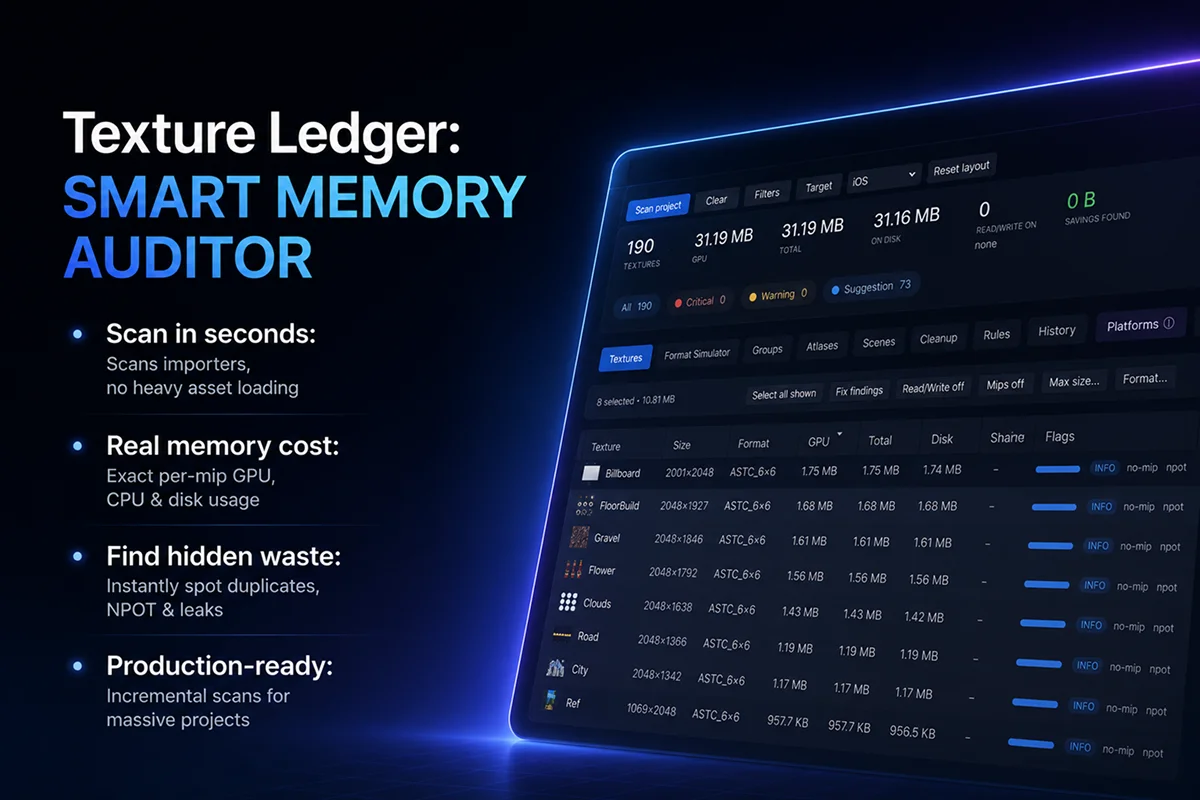
Why Texture Ledger?
REAL MEMORY COST
Know what your textures actually cost. Accurate per mip level memory, with GPU, CPU and disk usage shown separately
FIND HIDDEN WASTE
Find what is eating your texture budget. Read/Write, bad formats, MipMaps, oversized textures, NPOT padding, duplicates, unused textures and atlas issues
FORMAT SIMULATOR
Compare formats instantly. See the cost of every format your target platform supports, without reimporting
SAFE BULK FIXES
Fix hundreds of textures in seconds. Preview changes before applying them, batch edit, and undo everything in one step
FAST CLEANUP
Find duplicates, possibly unused, cubemaps, volumes and render textures
RULES & PRESETS + CI
Keep your project optimized. Create texture rules, use presets, apply them on import and validate them in CI
BUILT FOR PRODUCTION
Optimised to handle a huge volume of textures. Scans importers instead of loading every texture. Cancellable and incremental scans
More
Per scene memory breakdown
Snapshot history
Sprite atlas analysis
JSON / CSV export
Modern UI Toolkit interface (Dark, Light Unity themes)
Folder filters and ignore lists
Inline importer editor
Before & after previews
Platform overrides
Unity versions LTS (tested)
Unity 2022.3 and newer, including Unity 2023, Unity 6, 6.1, 6.2, 6.3, 6.4 and 6.5
Supported platforms
Analysis and rules cover PC (Windows, macOS, Linux), Android, iOS and WebGL
Editor-only: nothing ships in your build
A note on what it doesn't do
It measures cost, not quality. A format that halves memory may look unacceptable on your art, and only your eyes can decide that. The tool prices every option and gets out of the way
Advice
Start with the Textures tab sorted by Total, fix the top twenty, then take a snapshot. Once you know what your project's settings should be, write them down as rules and put the CI check in your build. That is the difference between one cleanup afternoon and a project that stays clean
Support
Questions, bug reports and feature requests go to our Discord, and you will get an answer from the people who wrote the tool
The inspector tells you a texture's dimensions and format. It doesn't tell you what that costs, and it certainly doesn't tell you which forty of your two thousand textures are worth an afternoon
Texture Ledger answers both, and then lets you act on the answer in the same window. The measurement is honest arithmetic rather than a rule of thumb, and every step of it is documented in the tool itself
Why Texture Ledger?
REAL MEMORY COST
Know what your textures actually cost. Accurate per mip level memory, with GPU, CPU and disk usage shown separately
FIND HIDDEN WASTE
Find what is eating your texture budget. Read/Write, bad formats, MipMaps, oversized textures, NPOT padding, duplicates, unused textures and atlas issues
FORMAT SIMULATOR
Compare formats instantly. See the cost of every format your target platform supports, without reimporting
SAFE BULK FIXES
Fix hundreds of textures in seconds. Preview changes before applying them, batch edit, and undo everything in one step
FAST CLEANUP
Find duplicates, possibly unused, cubemaps, volumes and render textures
RULES & PRESETS + CI
Keep your project optimized. Create texture rules, use presets, apply them on import and validate them in CI
BUILT FOR PRODUCTION
Optimised to handle a huge volume of textures. Scans importers instead of loading every texture. Cancellable and incremental scans
More
Per scene memory breakdown
Snapshot history
Sprite atlas analysis
JSON / CSV export
Modern UI Toolkit interface (Dark, Light Unity themes)
Folder filters and ignore lists
Inline importer editor
Before & after previews
Platform overrides
Unity versions LTS (tested)
Unity 2022.3 and newer, including Unity 2023, Unity 6, 6.1, 6.2, 6.3, 6.4 and 6.5
Supported platforms
Analysis and rules cover PC (Windows, macOS, Linux), Android, iOS and WebGL
Editor-only: nothing ships in your build
A note on what it doesn't do
It measures cost, not quality. A format that halves memory may look unacceptable on your art, and only your eyes can decide that. The tool prices every option and gets out of the way
Advice
Start with the Textures tab sorted by Total, fix the top twenty, then take a snapshot. Once you know what your project's settings should be, write them down as rules and put the CI check in your build. That is the difference between one cleanup afternoon and a project that stays clean
Support
Questions, bug reports and feature requests go to our Discord, and you will get an answer from the people who wrote the tool